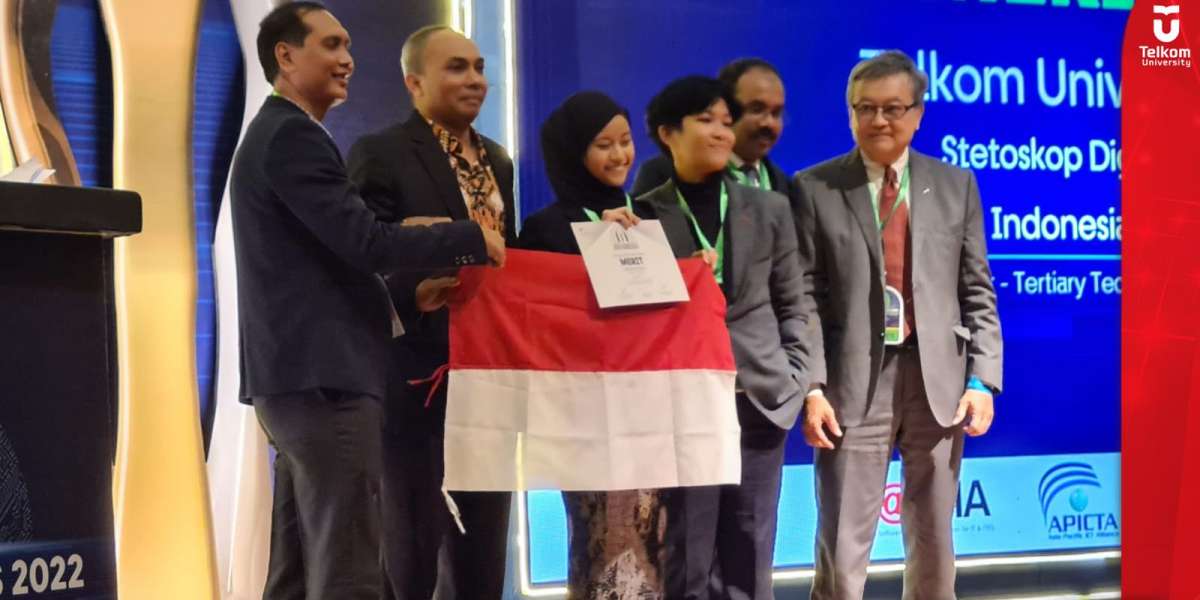
Telkom University Wins APICTA Awards 2022 Again
International achievements were again achieved at the APICTA (Asia Pacific ICT Alliance) Awards 2022 in Pakistan. The event, held since 2001, was attended by more than 200 teams from all countries in the Asia Pacific. To this year's event, Telkom University sent two teams: the Amons team consisting of I Putu Bagus Erix Wijaya (Bachelor of Informatics), Mar'i Fauzan Rambe (Bachelor of Informatics), Michael Fernandito Sanfia (Bachelor of Information Technology), Adelio Ferhan Soebroto (Bachelor of Information Systems); and the Digital Stethoscope Team consisting of Muhammad Rafli Ramadhan (Bachelor of Informatics), Nariswari Yoga Nandita (Bachelor of Informatics), Nur Afina Rahmani (Bachelor of Informatics), and Wandi Yusuf Kurniawan (Bachelor of Informatics). Both teams are in the Student Tertiary category.
Satria Mandala, Ph.D., as the supervising lecturer, explained that Amons is a system for monitoring arrhythmias from anywhere and at any time by utilizing Internet of Things (IoT) technology. Amons uses artificial intelligence to detect and predict several types of arrhythmias such as Premature Ventricular Contraction (PVC), Premature Atrial Contraction (PAC), Atrial Fibrillation (AF) which is often found in Stroke patients and Ventricular Tachycardia/Ventricular Fibrillation (VT/VF) a deadly type of arrhythmia.
Amons can be used on Android, computers, or laptops. On Android, Amons' predictions are near-real-time and focused on potentially fatal arrhythmias, namely VT/VF. When VT/VF is detected, an alert is sent to the server for forwarding to a doctor. For the computer or laptop application, detection and prediction are performed for all four types of arrhythmias (PVC, PAC, AF, and VT/VF). However, on computers or laptops, detection and prediction are on-demand because they serve a large number of users.
Meanwhile, Satria Mandala, Ph.D., a member of the Digital Stethoscope team, explained that the Digital Stethoscope offers more capabilities than a standard stethoscope. It's equipped with the ability to predict Valvular Heart Disease (VHD), or heart leakage.
The Digital Stethoscope System has an Android app and a web-based application for computers or laptops. Recording and predicting heart sound data for VHD can be done on both Android and laptop computers. Similar to Amons, the digital stethoscope also features machine learning-based VHD prediction.
The stethoscope hardware, Android app, and web app on a computer or laptop are connected via Internet of Things (IoT) technology. VHD detection on Android is performed in real time, and alerts are sent directly to the server, then forwarded to the doctor, who can then access it via the web-based application on the laptop. On the server, heart sound data is predicted on-demand, as it must serve a large number of patients for VHD detection.
Satria hopes this achievement can continue to improve and Telkom University can achieve a championship. "This is an extraordinary achievement. Hopefully, we can improve on it in the future to become a winner," he said.
APICTA itself is an alliance of ICT organizations to build and improve networks to enhance cooperation in the ICT sector and increase technological innovation and encourage ICT development for the global market.
While the APICTA Awards is an international awards program that aims to raise ICT awareness in society and help bridge the digital divide, this program is designed to stimulate ICT innovation and creativity, improve economic and trade relations, facilitate technology transfer and offer suitable business opportunities through exposure to venture capitalists and investors.